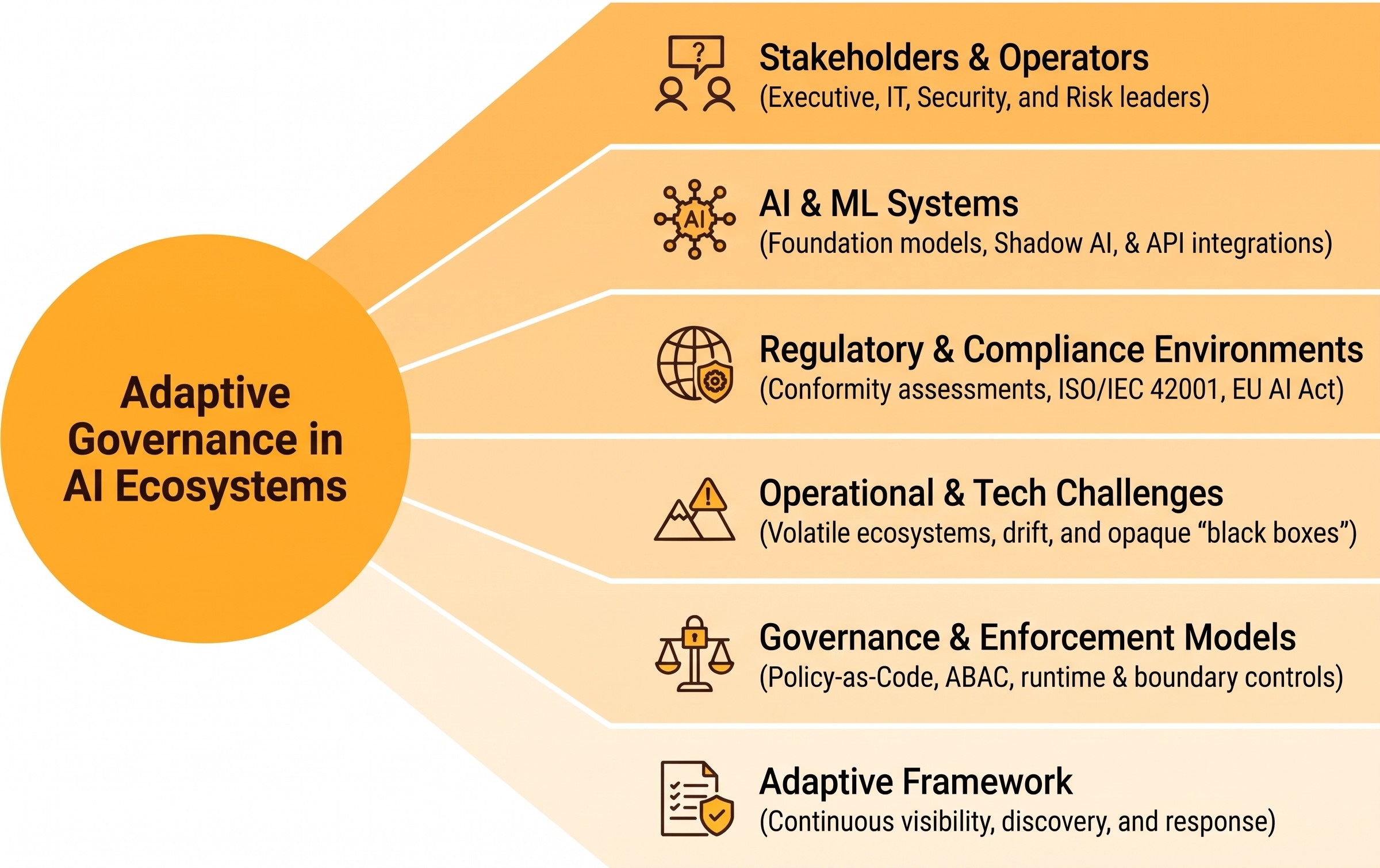
Organizations today operate in a technological landscape defined by complex supply chains, interconnected systems and rapid innovation. As artificial intelligence fundamentally reshapes how business is conducted, governance and security leaders are realizing that traditional and backward-looking AI governance frameworks are no longer sufficient.
Artificial intelligence operates in an environment characterized by volatility, uncertainty, complexity and ambiguity (VUCA). To safely harness the strategic advantages of AI, organizations must evolve beyond rigid, top-down bureaucracies and static compliance checklists.
They require Adaptive Governance.
Adaptive governance is a flexible system of rules, norms and decision-making processes that allows institutions to adjust and evolve as conditions change. It is uniquely suited for solving problems that are complex, uncertain and involve multiple actors across an ecosystem.
Here is how to architect an adaptive AI governance program that balances stability with continuous innovation.
The Four Pillars of Adaptive AI Governance
An organization should build its AI governance program upon four foundational pillars to achieve stability, accountability and responsiveness:
Decentralized & Participatory Oversight: Traditional IT governance often relies on a single and centralized bottleneck. Adaptive governance involves multiple actors such as executives, data privacy leads, security architects and developers. By empowering product teams with clear boundaries, organizations foster community-level networks where security is a shared responsibility rather than a localized mandate.
Iterative Learning & Feedback Loops: AI models are not deploy-and-forget assets; they drift, learn and change. An adaptive program treats policies and decisions as ongoing experiments. Continuous monitoring, error reporting and regular feedback loops drive continuous improvement to ensure the governance model learns as fast as the AI it oversees.
“AI governance is like training a new employee: you don't just onboard them on day one and never look at their work again. You provide continuous feedback, correct their course when they make mistakes, and update your company guidelines as their role evolves.”
Balancing Stability and Change: True adaptive governance is "ambidextrous”. It permits rapid adaptation to environmental turbulence such as the release of a new foundation model or a shift in the EU AI Act without losing core institutional integrity. The program must be established as a distinct architectural effort to anchor its stability in robust standards like ISO/IEC 42001 while allowing the day-to-day operational execution to remain highly agile.
Context-Driven Rules: Manual, static role-based security control cannot keep pace with AI. Adaptive governance shifts policies based on real-time data and risk profiles. This requires implementing policy-as-code mechanisms and security controls like Attribute-Based Access Control (ABAC) to enforce guardrails dynamically based on shifting human and operational contexts.
The Implementation Framework: Striking the Balance
Implementing a real adaptive governance framework requires streamlining decision-making to allow for swift adjustments. When team identifies the need to pivot a strategy or modify a model's scope, the governance structure should facilitate a rapid response rather than halting development.
The Litmus Test: Is Your Governance Aligned? To assess if your current AI governance is truly adaptive, boards, executives and assessors must ask the following questions:
Are our policies enforced dynamically at runtime or do they rely on manual and point-in-time reviews?
If a critical flaw is discovered in a third-party AI model today, can we identify every internal system utilizing that model within hours or limited number of days?
Is our governance framework distinctly separated from our day-to-day IT operations and allow oversight to scale independently of deployment speed?
Do our product and engineering teams feel that governance accelerates their time-to-market safely or do they view it as a bureaucratic roadblock?
Remediation Activities to Close the Gap: The following activities must be implemented If the answers to the above questions reveal a reliance on traditional approaches:
Deploy Shadow AI Discovery: You cannot govern what you cannot see. Implement automated discovery tools to continuously discover and inventory hidden AI assets, APIs and datasets across the enterprise. Maintaining this situational awareness including identifying shadow AI and tracking transparent model and data cards for all models in use is your first line of defense against complex supply chain risks.
Establish Automated Conformity Assessments: Transition from manual spreadsheets to automated mapping against frameworks like the NIST AI RMF, ISO 42001, applicable location regulations and polices to ensure continuous compliance.
· Detecting "Weak Signals": An adaptive governance program establishes the telemetry necessary to detect early indicators of systemic issues before they result in a breach or failure.
Integrate Policy-as-Code Gateways: Embed automated policy checks directly into the development pipeline, ensuring models cannot be deployed if they violate established risk thresholds.
Initiate Behavioral Change Campaigns: Secure robust executive sponsorship to champion a cultural shift. Train teams to view governance not as a barrier but as the brakes on a sports car designed to let them drive faster, safely.
Navigating the Challenges to Find the "Sweet Spot"
Transitioning from traditional to adaptive governance presents significant challenges. It requires intricate behavioral shifts, process adjustments and complex tool integrations.
Resistance is natural as individuals navigate innovative approaches. Aligning these new processes with evolving methodologies requires careful calibration to avoid operational disruptions. Furthermore, securing executive sponsorship that truly champions change rather than simply signing off on budgets and technical mandates.
Navigating these obstacles with resilience and strategic acumen is pivotal. Adaptive AI governance is a continuous effort to find the sweet spot where structures, processes and people combine. By prioritizing continuous collaboration and incremental delivery, organizations can move beyond reacting to risks, ambiguities and uncertainty into a sustained competitive advantage.