The "People, Process, Technology" Framework is Dead. Enter the cTOM
The era of bolting AI onto legacy business structures is over. While many organizations are successfully launching Generative AI pilots, they are hitting a massive wall when trying to scale. Why? Because they are deploying cognitive technologies into traditional, industrial-era operating models.
By synthesizing the structural rigor of enterprise Target Operating Models (like KPMG’s 6-layer architecture) with the agility of AI-scaling frameworks (like PwC’s AI Use Case Factory), we can engineer something entirely new.
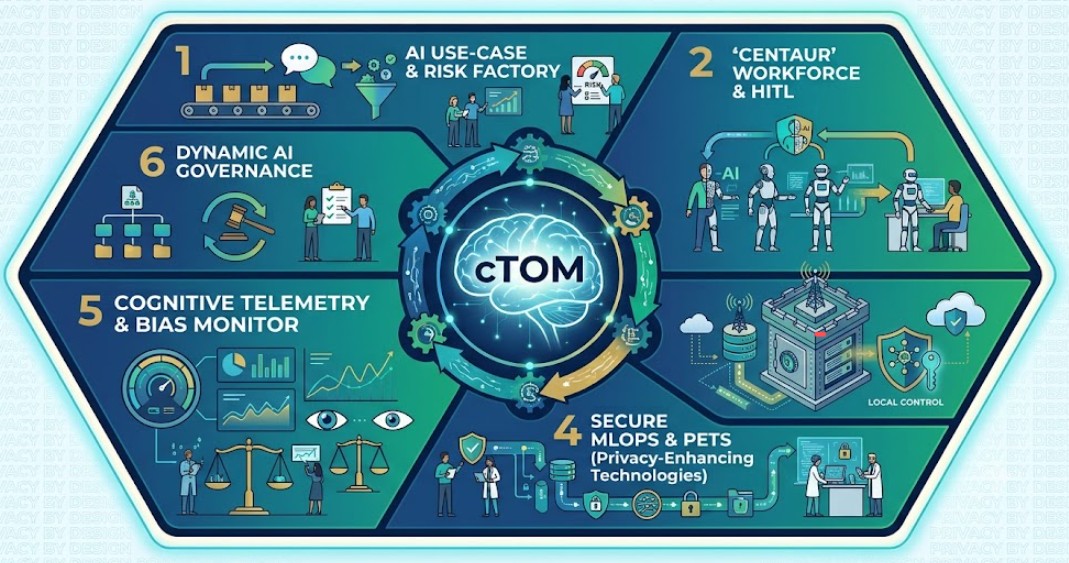
As an AI Governance, Cybersecurity and Privacy consultant, I call this the Cognitive Target Operating Model (cTOM) a framework where AI, Cybersecurity and Data Privacy are not just aligned but fused into the business DNA.
Here is how forward-thinking enterprises are redesigning their operations to scale AI securely and profitably.
The Cognitive Target Operating Model (cTOM)
To move from isolated AI experiments to an enterprise-wide "AI Factory," you need a 6-layer architecture built on a foundation of Zero Trust and Privacy by Design:
1. The AI Use-Case & Risk Factory (Functional Processes)
The Shift: We must move beyond traditional process mapping to "Cognitive Workflows."
The Innovation: Don't just build a pipeline for AI ideas; build a Risk-Assessed Use Case Factory. Before an AI agent is deployed, it must undergo ethical, risk and privacy impact assessments (PIAs). If an AI use case cannot demonstrate clear ROI and regulatory compliance (e.g., EU AI Act), it doesn't leave the factory.
2. The "Centaur" Workforce (People & Culture)
The Shift: Stop viewing AI as a tool and start viewing it as a team member.
The Innovation: Redesign job architectures around human-AI collaboration (Centaur teams). However, from a governance perspective, establish strict Human-in-the-Loop (HITL) accountability. AI makes predictions; humans make decisions. Your operating model must clearly define legal and operational accountability for algorithmic outputs.
3. Sovereign Service Delivery (Ecosystem & Partners)
The Shift: Moving from centralized IT to decentralized, secure API ecosystems.
The Innovation: Whether you are fine-tuning open-source models internally or calling external LLMs via APIs, your delivery model must be Sovereign and Zero Trust. This means implementing rigorous vendor risk management for AI supply chains and ensuring proprietary data never trains external models without explicit consent.
4. Secure MLOps & PETs (Technology Infrastructure)
The Shift: Traditional IT infrastructure cannot support the continuous lifecycle of Machine Learning.
The Innovation: Embed Privacy-Enhancing Technologies (PETs) directly into your MLOps pipelines. Utilize synthetic data for training, differential privacy for analytics and automated guardrails that block prompt injection attacks. Security isn't a gate at the end of the pipeline; it is code built into the deployment platform.
5. Cognitive Telemetry (Performance & Insights)
The Shift: Looking past static KPIs to continuous algorithmic monitoring.
The Innovation: Traditional dashboards track uptime and cost. A cTOM requires "Cognitive Telemetry" real-time dashboards that monitor model drift, algorithmic bias, data toxicity and hallucination rates. If an AI model's accuracy degrades or starts exhibiting bias, the operating model must dictate automated rollback procedures.
6. Dynamic AI Governance (The Trust Anchor)
The Shift: Moving governance from a compliance bottleneck to a strategic enabler.
The Innovation: Governance must be cross-functional, bridging the CISO, Chief Data Officer, and Legal. By operationalizing frameworks like NIST AI RMF and ISO 42001, governance becomes dynamic. It ensures ethical AI usage, builds customer trust, and proves to regulators that you are in complete control of your autonomous systems.
The Strategic Takeaway: An AI model is only as effective and as safe as the operating model that houses it. If you try to run a current AI strategy on a legacy operating models, you are simply amplifying your security risks and throttling your ROI. The organizations that win the AI race won't just have the best models; they will have the most resilient, governed and adaptable operating structures.
Are you treating AI as just another IT project or are you redesigning your operating model to become a truly cognitive enterprise?
#AITargetOperatingModel #GenerativeAI #AIGovernance #MLOps #Cybersecurity #DataPrivacy #DigitalTransformation #Innovation #CISO #EnterpriseArchitecture